Commercial Roofers in Downtown Laredo
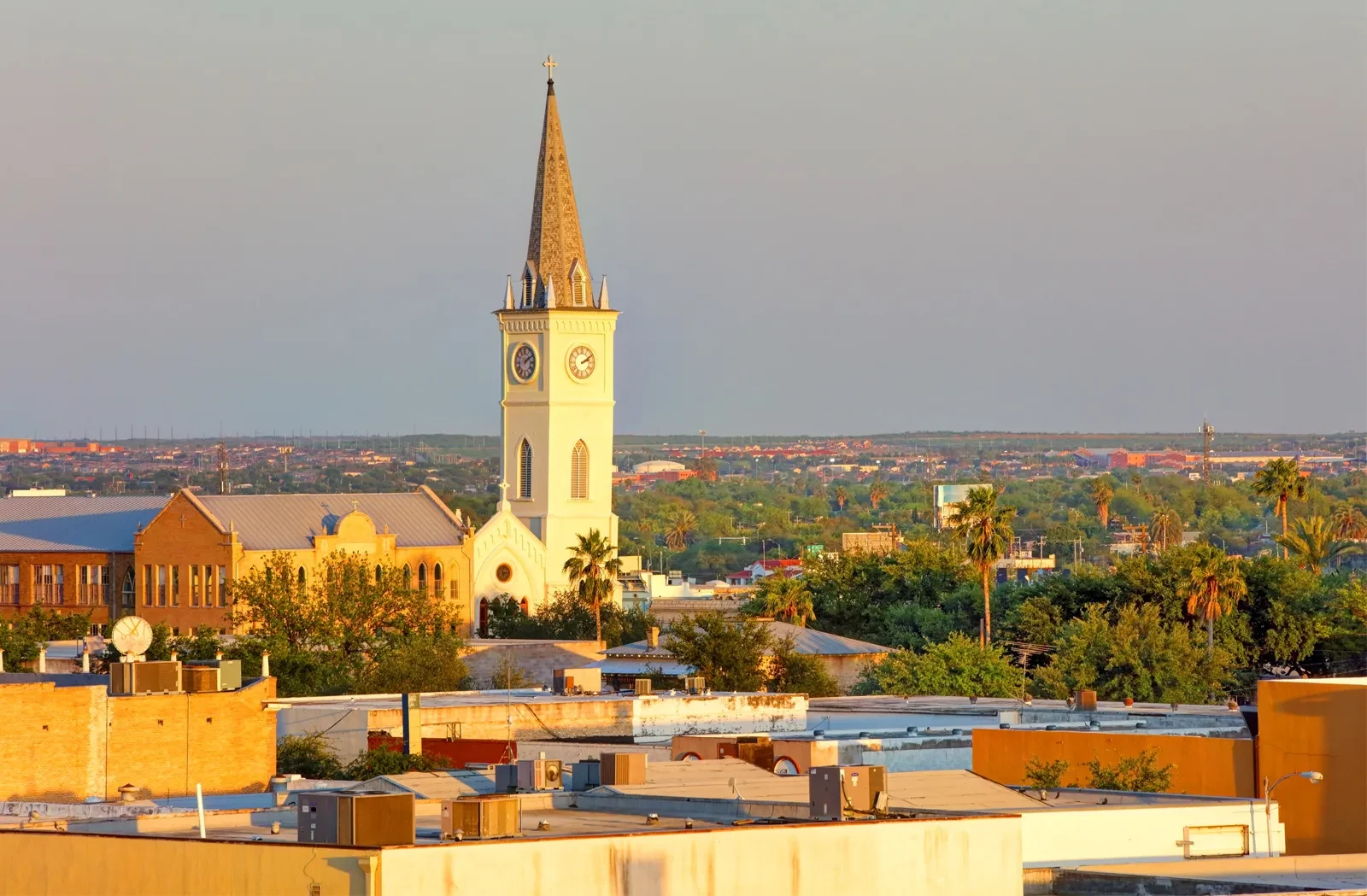
Commercial roofing in Downtown Laredo should begin with a documented assessment of membrane condition, seams, flashings, drainage, penetrations, and moisture before repair, coating, or replacement is selected. Downtown Laredo's commercial core, from San Agustin Plaza out past the international bridges, is older masonry buildings with parapet-wall flat roofs. Most of the leak calls we get here start at the parapet, not out in the field of the roof.
Building Stock Around San Agustin Plaza and the Bridge District
Customs brokerage offices, law firms, and small retail cluster near the Juarez-Lincoln and Gateway to the Americas bridges, alongside the Webb County Courthouse and City Hall. Most of these are older masonry buildings with built-up or modified bitumen roofs, some carrying a single-ply overlay added at some point along the way.
Further out, Convent Avenue and San Bernardo Avenue carry a retail and restaurant strip in older buildings, flat roofs with roof-mounted signage and window-unit or packaged AC bolted straight into the membrane.
Several of these buildings have changed use over the decades, from residential to retail to office space, without the roof ever getting a full survey to match. We regularly find abandoned equipment curbs and capped-off penetrations from a prior use still sitting in the field, sealed well enough for years but worth checking rather than assuming they're sound forever.
Parapet Walls Are the Weak Point
Coping metal failure, deteriorating mortar joints, and membrane termination pulling away from the wall base cause more leaks downtown than the field membrane ever does. These buildings were built before current edge-metal detailing standards existed, and retrofitting proper coping and termination bars is often the single highest-value repair we make on a downtown building.
Water that gets behind a parapet doesn't always show up as a ceiling stain right below it. It can travel and drop several bays over, which is why a leak downtown often takes more investigation than a leak in a simple warehouse field.
Brick and block parapets downtown also move seasonally as the mortar expands and contracts, opening hairline gaps at the wall-to-membrane joint that widen year over year if nobody re-seals them. That slow movement is a big part of why a parapet repair that looked fine two years ago can be leaking again today.
Working Downtown Means Working Around the City
Narrow downtown streets, shared walls, and tight lot lines mean smaller equipment and more material carried by hand instead of craned onto the roof. We coordinate permitting and inspection with the City of Laredo the same way any downtown contractor has to, and where a building sits near a designated historic structure, we account for that when touching visible exterior elements like cornices or coping.
Parking and staging is its own challenge on these blocks. We plan material drops and dumpster placement around the building's actual street access rather than assuming a truck can simply pull up out front the way it could at a suburban strip center.
Retail and Office Roof Drainage on Older Flat Roofs
A lot of downtown buildings were built before drainage engineering caught up with flat-roof design, relying on a single interior drain or a couple of undersized scuppers for a roof several times that size by today's standard. Ponding is common on the older built-up sections downtown, and tapered insulation during a recover is usually the actual fix, not another round of patching around the low point.
Shared-wall buildings also complicate drainage, since a scupper discharging onto a neighboring property or a shared alley can become a dispute between owners if it isn't routed properly. We flag that early rather than leaving it for the owner to sort out after the work is done.
- Deteriorated coping metal allowing water behind parapet walls
- Cracked mortar joints letting moisture into wall cavities
- Undersized, single-point roof drains original to older construction
- Old built-up roofs patched repeatedly instead of properly re-flashed at the termination
- Rooftop signage brackets penetrating membrane without proper flashing
- HVAC units added decades after the original roof install, with curbs never resealed
Insurance and Documentation for Downtown Owners
Older buildings draw more questions from insurers before binding or renewing a commercial property policy. We provide the photo and condition documentation from an inspection that an owner can hand to their agent, without promising what the underwriter decides to do with it.
What Downtown Building Owners Ask Us
Why do downtown buildings leak at the parapet instead of the roof field?
Because most were built before modern edge-metal and termination detailing, so the wall itself is often the entry point for water, not the flat membrane in the middle of the roof.
Can you match repairs to a historic building's exterior appearance?
Yes, we account for visible elements like coping profile and cornice details on buildings where that matters to the owner or to a historic district.
Do you coordinate with the City of Laredo on permits for downtown commercial roof work?
Yes, that's standard for any roofing scope requiring a permit downtown, and we handle that coordination as part of the job.
What's the fix for a flat roof that's been ponding for years?
Usually tapered insulation added during a recover or replacement, since another patch on top of an existing low point just delays the same problem.
Can a roof inspection help before we renew insurance on an older downtown building?
It can give you documented condition and photos to share with your agent ahead of renewal, which is useful information even though we can't speak to how an underwriter will use it.