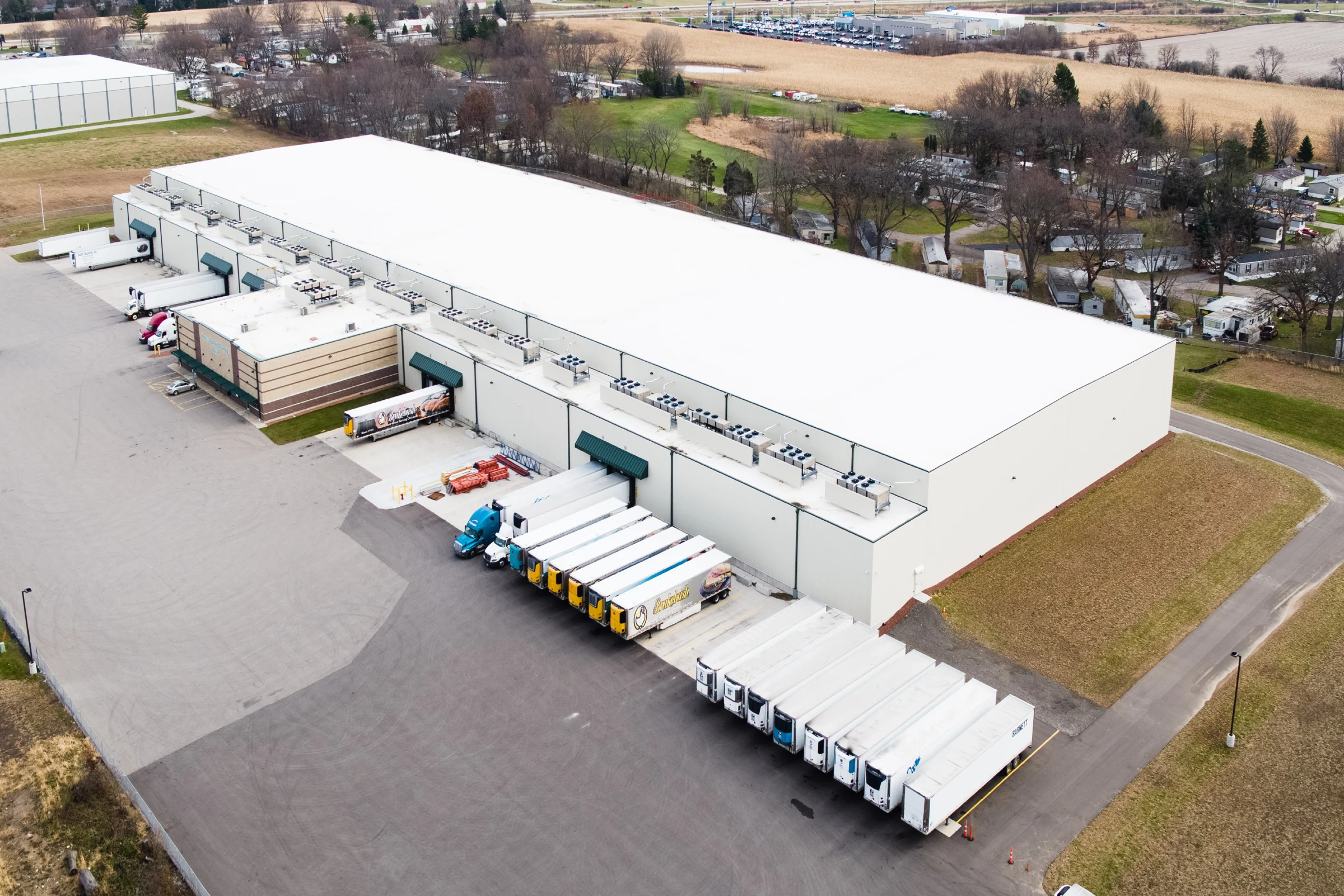
Cold Storage Roofs Fight Condensation From Both Directions
Produce and reefer cargo moving through the Laredo port needs cold storage buildings that hold temperature reliably, and the roof over a freezer or cooler works differently than the roof over an ordinary warehouse. We handle the vapor-barrier and insulation details that regular flat-roof crews often miss.
Vapor Drive Runs the Opposite Way on a Freezer Roof
On a conditioned cold-storage building, warm humid air outside pushes moisture toward the cold interior, which means the vapor barrier has to sit on the warm side of the insulation, the reverse of how most commercial roofs are detailed. Get that layer in the wrong place and condensation forms inside the roof assembly where nobody can see it until the insulation is already soaked.
We've opened up cold-storage roofs where the membrane looked fine from above but the insulation underneath was saturated, which tanks the R-value and the building's refrigeration efficiency long before it shows up as a visible leak.
Any coating or overlay work on a cold-storage roof gets checked against the vapor barrier detail first, because painting over a moisture problem just traps it.
We also look at how the roof assembly transitions at parapet walls and equipment curbs, since those are the spots where a vapor barrier is easiest to install incorrectly and hardest to inspect once the roof is closed back up.
Frost and Ice Buildup at Loading Docks
Reefer trailers docked against a cold-storage building create a cold spot right at the dock seal, and that area sees frost and occasional ice buildup that regular roof sections nearby don't. Flashing and drainage right around dock seal penetrations takes more attention here than on a standard warehouse.
We look closely at dock-area roof sections during inspection because that's where thermal bridging and condensation problems usually show up first, well before the rest of the roof shows any wear.
Ice damming at parapet edges near refrigerated dock areas is a drainage question as much as a cold-weather nuisance, and we correct the slope or scupper sizing where it's causing repeat problems.
Dock seal gaskets themselves also take a beating from the constant docking and undocking of reefer trailers, and while that's not strictly a roofing component, the flashing directly around a dock seal often shows wear from the same vibration and movement that wears out the gasket.
Product Loss Makes Leak Response Time-Sensitive
A leak over an ordinary warehouse floor is a maintenance issue. A leak over palletized produce or frozen inventory in a cold-storage building is a product-loss issue on a clock, and the insurance conversation is different because of it.
We prioritize cold-storage callbacks and document the leak location, extent, and any visible product exposure immediately, because that record matters both to the roof repair and to whatever claim gets filed for the inventory underneath.
We describe what we document, not what a claim will pay out. Getting the photo and moisture-scan record right at the time of the leak is the part we control.
For buildings running multiple cold-storage zones at different temperatures, we also note which zone was affected, since the roof assembly detail and vapor drive direction can differ zone to zone even within the same building footprint.
- Vapor barrier correction for freezer and cooler roof assemblies
- Wet insulation identification and replacement
- Dock-area frost and ice damage repair
- Reflective membrane installation for cold-storage building envelopes
- Moisture-scan roof surveys
- Emergency leak response with product-loss documentation
Moisture Surveys Before Any Recover
We won't recover a cold-storage roof without checking for wet insulation first, because covering saturated insulation with a new membrane locks the moisture problem in rather than fixing it.
Infrared and moisture-meter surveys on these roofs tell us which sections need insulation replacement and which sections are dry enough to recover as-is, which keeps the project cost tied to actual conditions instead of a blanket tear-off.
On a building running compressors around the clock, we also plan work sequencing so refrigeration equipment access on the roof isn't blocked during the project.
We share the survey results plainly, section by section, so a facility manager can see exactly where the moisture is and why we're recommending insulation replacement in one area and a straight recover somewhere else on the same roof.
For a building expanding its cold-storage footprint to handle more produce volume through the port, we also flag where the existing roof assembly's insulation value falls short of what the new refrigeration load will actually need, rather than assuming the old spec still fits an expanded operation.
Common Cold Storage Roofing Questions
Why does a cold-storage roof leak differently than a regular warehouse roof?
Vapor drive runs toward the cold interior, so moisture problems often start inside the insulation layer rather than at the surface, which means visible leaks show up after the damage is already done.
How do you check for wet insulation without tearing the roof open?
We use infrared scanning and moisture-meter probes to map wet areas before quoting any recover or replacement work.
Do you work around active refrigeration equipment on the roof?
Yes. Compressor racks and condensers stay operational during our work, and we sequence crew movement to keep access clear for your maintenance staff.
What happens if a leak occurs directly over stored product?
We respond as a priority call, document the leak and any visible product exposure with photos and moisture readings, and dry in the area immediately.
Can a cold-storage roof be coated instead of replaced?
Only if the vapor barrier and insulation underneath test dry. A coating over wet insulation just seals the moisture in.