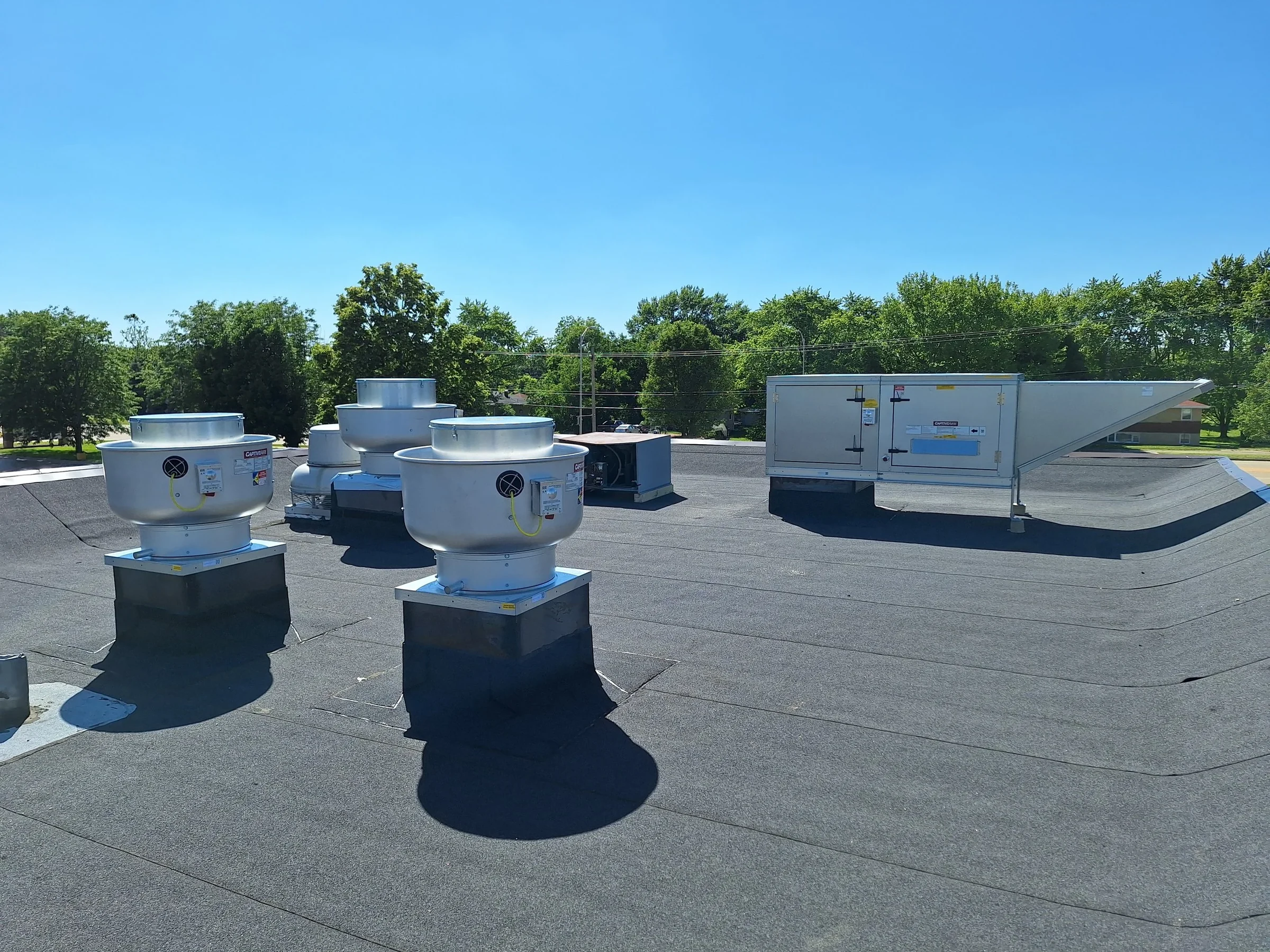
QSR Roofs Along Mines Road Take More Grease and Heat Than the Building Size Suggests
Fast food restaurants serving truck traffic along Mines Road and the I-35 corridor run kitchen exhaust systems hard, almost around the clock, and the roof around a QSR's hood vent penetration ages differently than the rest of a small building's membrane. We size our work to that reality.
Grease Exhaust Penetrations Are the Weak Point on Almost Every QSR Roof
A commercial kitchen exhaust hood pushes hot, grease-laden air through a roof curb continuously during operating hours, and that combination of heat and grease residue breaks down standard flashing sealant faster than anything else on a small-format restaurant roof.
We check hood vent curbs and surrounding membrane on every QSR inspection specifically because this is where we find active leaks most often, not in the open field of the roof.
Fire code also requires grease exhaust penetrations to be detailed and maintained a specific way, so we flash these to that standard rather than treating them like a standard HVAC curb.
Grease buildup on the roof surface itself around a poorly maintained exhaust vent is also a slip hazard for anyone who has to get up there for maintenance, and we clean and correct that buildup as part of any hood vent flashing repair rather than leaving it for someone else to deal with later.
Small Footprint, But No Room for Downtime
A QSR building is small compared to a warehouse or office complex, but drive-thru volume along a truck corridor like Mines Road means the restaurant can't afford to close during roof work, even for a building this size.
We schedule QSR roof projects around drive-thru and dine-in hours, staging material away from the drive-thru lane and customer parking, and we keep the kitchen exhaust system operational throughout the project wherever the work allows it.
For franchise locations, we also work within whatever brand standards apply to exterior appearance during and after the project.
We coordinate directly with the general manager on-site rather than routing every question through a corporate office, since decisions about staging and access timing usually need to happen faster than a corporate approval chain can move.
Truck traffic idling near a Mines Road location while waiting for a table or a drive-thru slot also means our staging has to account for larger vehicles than a typical suburban QSR sees, and we keep our equipment clear of any lane a full-size rig might need to use.
Fast Turnaround Matters More Here Than Elsewhere
A small QSR roof replacement is a shorter project than a warehouse-scale job by nature, but the expectation from ownership is usually a fast turnaround because every day of reduced operations affects a location that depends on high-volume, quick-service traffic.
We scope QSR roofs to move efficiently, with accurate initial measurements, material ordered before the crew arrives, and a tight schedule, rather than treating a small building as a lower priority just because of its size.
We still document everything the same way we would on a larger building, because a small roof still generates a real insurance claim if storm damage is the cause.
- Grease exhaust curb inspection and code-compliant flashing repair
- Fast-turnaround roof replacement for small-format restaurant buildings
- Scheduling around drive-thru and peak service hours
- Franchise exterior standard compliance during projects
- Emergency leak response near kitchen exhaust and cooking line areas
- Storm damage documentation for small-format commercial buildings
Working With Franchise Owners and Corporate Facilities Teams
Some QSR locations are owned by an individual franchisee making the call directly, and others answer to a corporate facilities team overseeing multiple locations across the region, and our communication changes depending on which one we're working with.
For multi-location franchise groups, we keep consistent documentation across restaurants so a regional facilities contact can track roof condition and repair history location to location.
For an individual owner-operator, we walk through the same findings directly and in plain terms, without assuming they have a facilities background.
We also flag when a small repair is starting to look like it's approaching the point of diminishing returns, since an owner-operator running a single location needs an honest read on when patching the same hood vent curb for the third time stops making financial sense compared to a fuller fix.
For a location coming up on a franchise remodel cycle, we time roof recommendations around that schedule where we can, since replacing the roof around the same window as an interior remodel is usually less disruptive than running two separate projects months apart.
QSR Roofing Questions Owners Ask Most
Why do fast food roofs leak around the exhaust hood more than anywhere else?
Continuous heat and grease exposure break down flashing sealant faster there than on the rest of the roof, and we check that area first on every inspection.
Can a roof replacement happen without closing the drive-thru?
In almost every case, yes. We stage material away from the drive-thru lane and schedule around peak service hours.
How long does a typical QSR roof replacement take?
Shorter than a large commercial building by nature of the smaller footprint, and we plan material and crew scheduling to keep the timeline as tight as the roof condition allows.
Do you work with franchise exterior appearance standards?
Yes, we account for brand standards during and after the project so the finished roofline matches what the franchise agreement requires.
Do you handle roofing for multi-location franchise groups?
Yes, and we keep documentation consistent across locations so a regional facilities contact can compare roof history restaurant to restaurant.